Speaking
Helping audiences see the hidden patterns shaping people, organisations and systems.
Ideas that connect psychology, systems thinking, complexity and human behaviour, delivered through stories, frameworks and, when appropriate, live music.
Who I work with
Pick the situation closest to yours. Every session uses the same live demonstrations, shaped for the people in the room.
For
Events and conferences
A talk your audience remembers
"I need a session people will still be talking about at the coffee break."
What we explore
Why well-meant solutions create new problems, shown live with an egg, a guitar and the Stroop test, then traced across business, health, technology and design.
Suggested format
Keynote or conference talk, 30 to 60 minutes.
For
Teams and leaders
When fixes keep coming back
"My team works hard on problems, but the same problems keep returning."
What we explore
Feedback loops and unintended consequences in your own work, with a simple three-step way to spot them: the symptom, the loop and the better question.
Suggested format
A 60 minute talk, a 2-hour session, or a half-day to multi-day workshop. One-on-one sessions for leaders on request.
For
Universities and business schools
A guest lecture students engage with
"I want students to experience systems thinking, not just hear about it."
What we explore
Complexity, feedback loops and order from chaos through live demonstrations and interactive apps, grounded in published research.
Suggested format
Guest lecture of 45 minutes to 2 hours.
For
Communities and meetups
An evening that sparks conversation
"I want a speaker who gets our members talking."
What we explore
One hidden pattern, made tangible on stage and traced across design, technology and everyday life.
Suggested format
Talk of 20 to 45 minutes plus discussion.
"An egg is a chicken's solution to the problem of making another egg."
Werner van Zyl, The Problem with Solutions
SIGNATURE TALK
The Problem
with Solutions
Every person solves problems. But what if every solution also creates a new system?
We are trained to solve problems by fixing what we can see. But in complex systems, interventions can create consequences that only appear later. This talk explores the hidden feedback loops, incentives and patterns that can turn good solutions into new problems.
The audience will explore:
- Why well-intentioned solutions can produce unintended consequences
- How feedback loops shape behaviour and outcomes
- Why complexity changes the way we should approach problems
- How seeing relationships differently can lead to better decisions
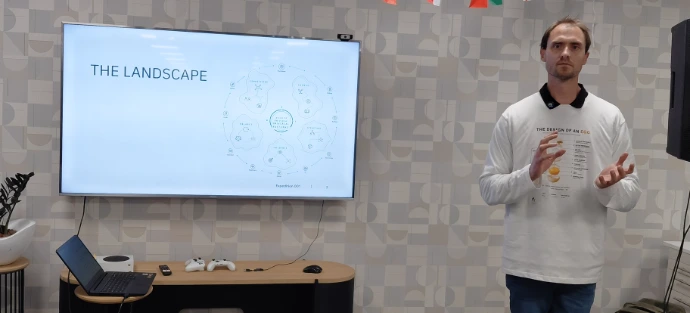
ABOVE: From a live presentation of The Problem with Solutions
Ideal for: Designers, leaders, professionals and curious thinkers.
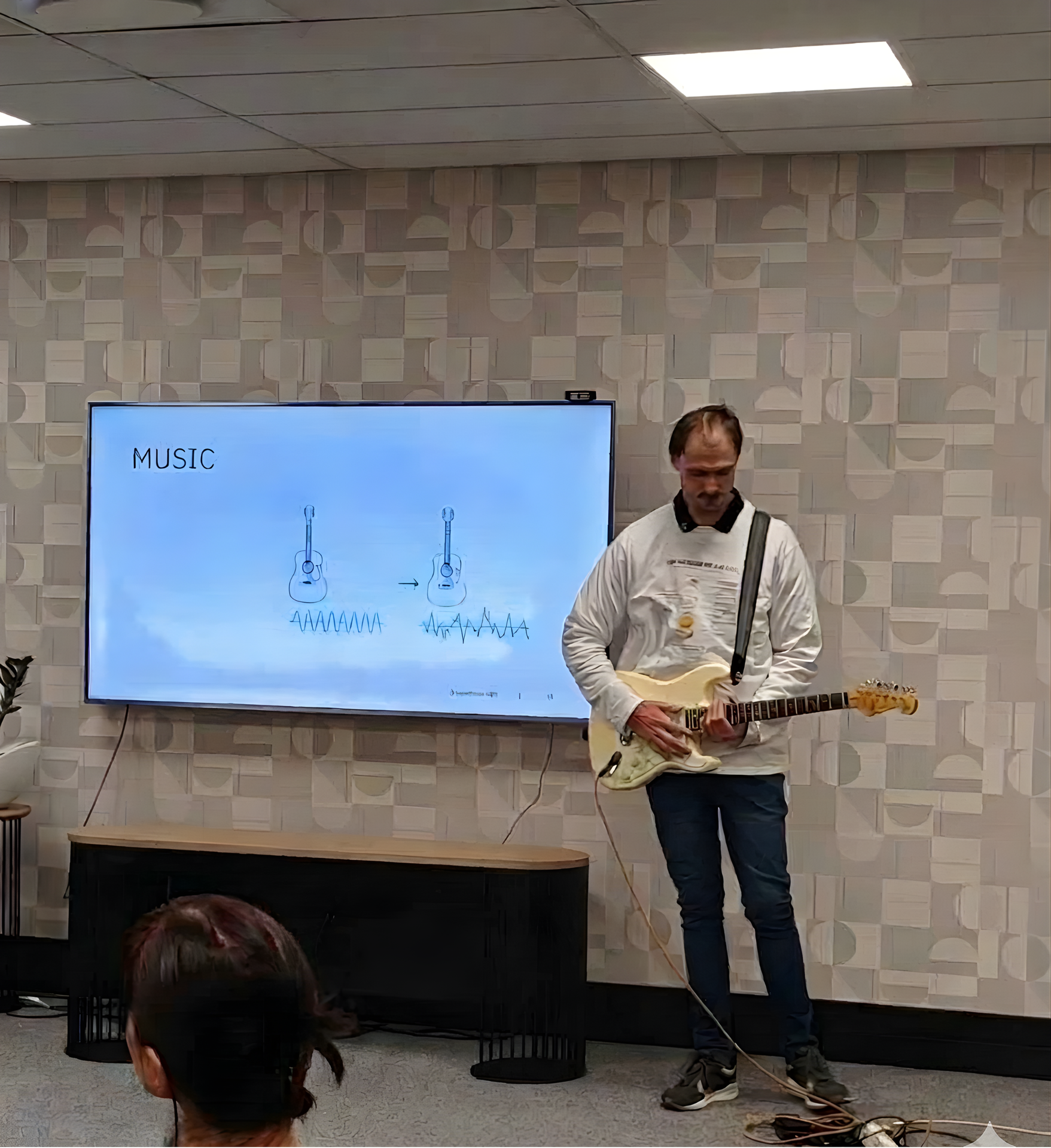
ABOVE: Using music to make complex systems tangible during The Problem with Solutions
Interested in bringing this talk to your organisation?
Other Talks
Why Smart People Repeat the Same Mistakes
Why intelligence doesn't protect us from predictable behavioural patterns.
The Hidden Patterns Behind Human Behaviour
What psychology reveals about the systems shaping the way we think, decide and act.
What Complexity Science Teaches Us About Leadership
Why leadership in complex environments requires a different way of seeing.
Recent talks
28 Oct 2026 · Business Social Network (BSN), Pretoria - Die probleem met oplossings (Afrikaans)
5 Oct 2026 · Akademia, Centurion, Pretoria - Probleme is die oplossing, innovation management lecture (Afrikaans)
20 Aug 2026 · Interaction Design Foundation (IxDF), Pretoria - Why do solutions become problems?
2024 · Monkey & River, Centurion, Pretoria - Human-centered Design
“A huge thank you to Werner R. van Zyl (DBL) for a thought-provoking session on The Problem with Solutions: When Good Intentions Have Unintended Consequences.”
Ursula Robbertze, Head UX Designer at Lightstone, after the IxDF Pretoria talk (August 2026)
Formats
From a short talk to a programme over several days. Every format uses live demonstrations and leaves people with something they can use on Monday.
| Format | Length | Best for |
|---|---|---|
| Talk or keynote | 20 to 60 minutes | Conferences, events, meetups and business networks |
| Lunch and learn | 45 to 60 minutes | Teams who want a fresh way of thinking over lunch |
| Interactive seminar | 2 hours | Teams and leaders who want to apply the ideas to their own work |
| Guest lecture | 45 minutes to 2 hours | Universities, business schools and executive programmes |
| Half-day workshop | 3 to 4 hours | Teams working on one real challenge together |
| Full-day workshop | 1 day | Leadership teams mapping the loops behind recurring problems |
| Multi-day programme | 2 or more days, together or spread over weeks | Organisations building systems thinking into how they work |
| One-on-one session | 60 to 90 minutes | A leader who wants to think through their own system challenge |
In person in South Africa and abroad, or live online for follow-up sessions. English or Afrikaans.
Not sure which fits?
Tell me about your audience and I will suggest the right format. A quick 15-minute call on Google Meet is often the easiest way to start.
Explore the Ideas
Why Smart People Repeat the Same Mistakes
Intelligence alone does not protect us from repeating patterns. Explore how habits, incentives, emotions and hidden assumptions shape our decisions, and learn why even the smartest individuals and organisations can become trapped in familiar cycles.
The Hidden Patterns Behind Human Behaviour
Why do people procrastinate, avoid change, seek certainty, or repeat the same relationship patterns? This talk reveals the deeper psychological and biological forces that influence behaviour, helping audiences better understand themselves and the people around them.
When Solutions Become Problems
Many of the challenges we face today began as attempts to solve yesterday's problems. Through stories, science and systems thinking, discover why well-intentioned solutions often create unintended consequences, and how to recognise them before they become tomorrow's challenges.
What Complexity Science Teaches Us About Leadership
A keynote exploring how leaders can create the conditions for adaptation, coordination and emergence rather than trying to control complex systems directly.